Indoor positioning has become one of the most requested extensions to traditional GPS tracking. Hospitals, warehouses, airports, schools, and manufacturing facilities all face the same limitation: GPS works outdoors, but once people or assets move inside a building, visibility disappears. For hardware manufacturers, demonstrating that this gap can be closed is becoming almost as important as supporting GPS itself.
For Meitrack, these requests arrive regularly. Their technical support team helps customers design solutions for projects that combine outdoor tracking with Bluetooth-based indoor positioning, and the T399L tracker already supported Bluetooth iBeacon scanning. The missing piece wasn't the hardware – it was the software pipeline that could transform nearby beacon data into something customers could immediately understand.
Because we have worked together for years across multiple device families, the Meitrack team decided to build the demonstration on flespi. Our platform already supported the device protocol, included an indoor positioning plugin capable of mapping BLE beacons onto uploaded floor plans, and offered an AI assistant that understood both the platform itself and protocol documentation. We've posted on how Jimi IoT examined codi already, and that was another challenge for him.
"Flespi already had relatively complete indoor positioning capabilities. The fact that your AI could understand and integrate our Bluetooth iBeacon protocol in a relatively short time was also an important factor."
From data to demo
The first connection quickly revealed one missing capability. While the T399L was successfully uploading Bluetooth data, several BLE parameters (0xFE70-0xFE73) were still arriving as raw payloads instead of parsed ble.beacons objects.
Instead of opening lengthy support discussions, the Meitrack team simply asked the AI assistant whether BLE support already existed, confirmed that the raw packets were arriving correctly, and uploaded the protocol documentation. Within a few days, the parser was added.
But for Meitrack, this wasn't really about decoding a few protocol fields. It was about moving from engineering data to something customers could instantly visualize.
"For presentations, we need intuitive, simple, and persuasive visuals – not a bunch of raw data."
Once the parser was available, the rest of the workflow came together almost immediately. Two floor plans were uploaded, two BLE beacons were placed on the map, and the tracker began switching between indoor locations exactly as expected. The demonstration wasn't designed to simulate a large deployment – it simply showed customers how their own buildings, beacons, and devices could work together.
Environmental monitoring became another useful addition. Meitrack's BLE temperature and humidity sensors behave like standard BLE beacons while also transmitting sensor readings, allowing the same infrastructure to support both indoor positioning and environmental telemetry. For applications such as healthcare, warehouses, or cold-chain logistics, this means a single BLE ecosystem can provide both location awareness and environmental monitoring.
A solution ready for customers
Today, the demonstration has become part of Meitrack's customer presentations, showing how the T399L and flespi can be combined into a complete indoor positioning solution rather than a collection of individual features.
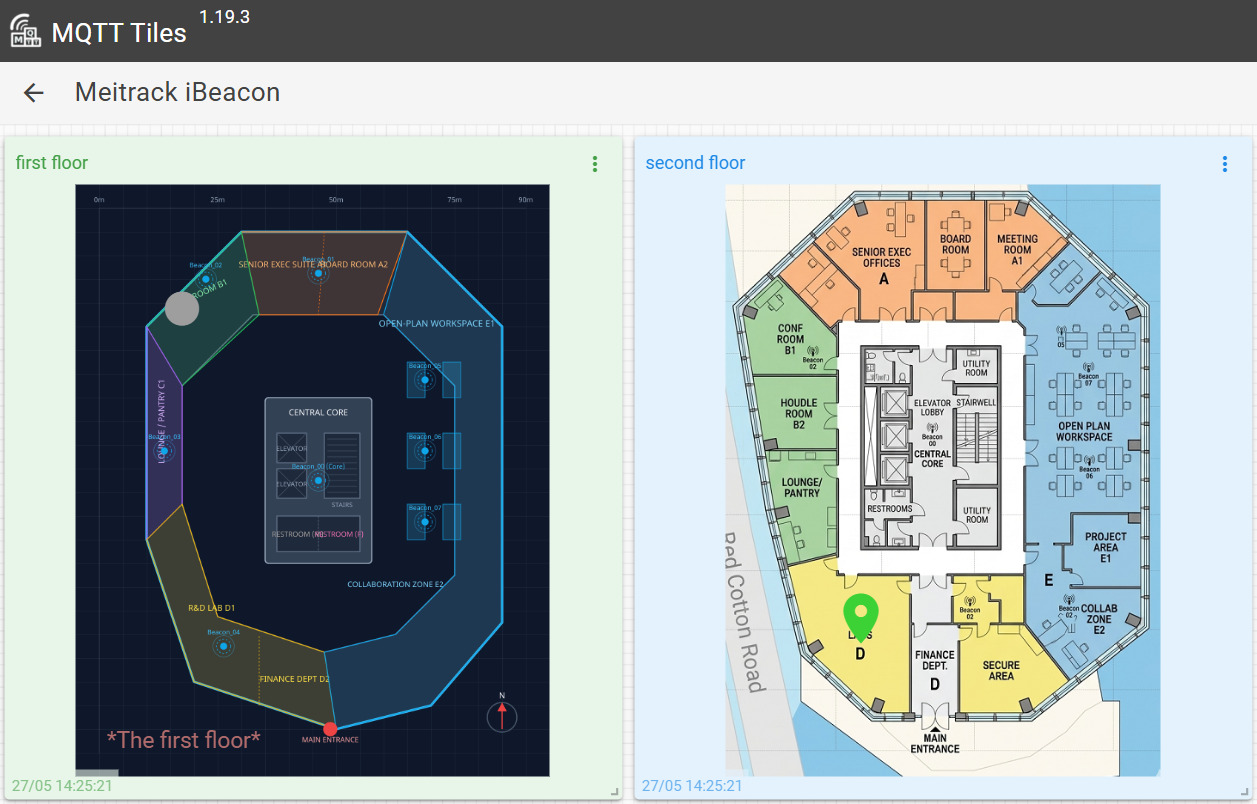
Interestingly, the most memorable part of the project wasn't the parser itself. It was the collaboration process. The engineer responsible for the whole track noted:
"Most of my recent collaboration with flespi has been assisted by AI. We believe your AI has reached a level comparable to an experienced engineer. Personally, I actually prefer communicating with AI because it processes information much faster and lets us focus only on the problem itself."
Although only a limited number of T399L devices currently rely on this functionality, the mature demonstration gives Meitrack considerably more confidence when discussing future indoor positioning projects.
Remarkably, when asked what advice they would give other hardware manufacturers, the answer was surprisingly simple:
"Make full use of the AI assistant. It seems to know everything about flespi's features and data."
As more device vendors look beyond simple GPS tracking toward complete indoor tracking solutions, the challenge is no longer collecting Bluetooth beacon data. It's showing customers how that data becomes a working system. For Meitrack, that meant turning raw BLE packets into a complete demonstration that customers could understand in minutes.
Next time, we'll share how major hardware manufacturers utilize flespi and how you can benefit from the platform as well.