We're continuing our interview series – today, we're featuring Geronimo Perez Terra, CTO and Co-founder at MyKeego, a carsharing and fleet management technology company based in Argentina.
MyKeego relies on flespi for vehicle connectivity, telemetry processing, fleet analytics, driver behavior monitoring, and integrations with external systems. After six years working extensively with our platform, Geronimo shares how AI agents have transformed his approach to device configuration, troubleshooting, testing, and automation – and where he still sees opportunities for improvement.

CTO and Co-founder, MyKeego
How did it all come together?
"I remember the very first version of Codi. Even back then, it was an interesting tool because I was constantly exploring the limits of what flespi could do.
We were developing different solutions for carsharing, driving behavior analysis, and fleet management, often with requirements that went beyond standard configurations.
Before Codi, solving these challenges frequently involved contacting the flespi development team directly. Having an AI assistant with knowledge of the platform made that process much more interactive. I could describe a requirement, discuss different approaches, and progressively refine a solution.
Today, the evolution is remarkable. Agents can go beyond providing guidance and actually perform operations: configuring calculators, investigating telemetry, adjusting settings, or cleaning up resources across an account.
I've been using flespi for approximately six years, and I'm very familiar with its capabilities. Yet I'm still discovering new ways to use the platform, particularly through AI agents and MCP integrations.
That's what makes this evolution so interesting: even experienced users can significantly expand what they're able to accomplish."
Testing without leaving the desk
"One of the biggest changes has been the speed of experimentation. Traditionally, developing a telematics feature involved configuration, physical testing, data collection, analysis, and multiple iterations. Sometimes that meant getting into a vehicle, driving around, generating specific events, and returning to examine the results.
I remember situations where testing a diagnostic trouble code required physically disconnecting components from a vehicle just to generate the appropriate event. Today, many of those scenarios can be reproduced using simulated telemetry, test packets, and calculators. That allows us to validate the logic much earlier, without depending on a physical test for every iteration.
AI has dramatically reduced the time required to explore and validate different approaches. Of course, faster development also means it's easier to experiment with ideas that may never reach production. The challenge becomes selecting which solutions are worth pursuing.
But overall, the ability to iterate quickly, simulate scenarios, and troubleshoot configurations has fundamentally changed our development process."
From advice to action
"My initial experience was with Codi, particularly while developing a driving behavior calculator. I wanted to understand the different approaches available for evaluating driving events and explore how to implement them within flespi.
What made Codi useful wasn't simply generating an answer. It was having an assistant that understood the platform well enough to discuss alternative configurations and help refine the implementation. With the introduction of agents, that value has expanded significantly.
The main advantage is the combination of deep platform knowledge and the ability to act on it. For example, an agent can help analyze how a calculator behaves, identify opportunities to improve its logic, integrate it with webhooks, and potentially execute the corresponding configuration changes.
Instead of simply explaining how something works, the agent can participate directly in getting it done."
Daily agent work
"Currently, I use the agents primarily through the flespi interface, especially for operational monitoring and troubleshooting. I have a telematics agent that helps me investigate events, verify device activity, and validate whether particular alerts should have been triggered.
For example, I might ask it to investigate a specific vehicle operation and determine whether the expected alert conditions were met. Another practical use case involves hardware installations.
When we're deploying devices with an installation partner, I can ask the agent to monitor whether a newly installed tracker starts reporting data to the expected channel. Previously, I would have needed to manually inspect the channel and verify the incoming traffic. Now, I can delegate that verification to the agent and use the result to confirm the installation.
I also use agents to cross-check information. Recently, I was validating fuel-efficiency calculations. I asked the agent to examine the underlying telemetry and independently verify whether the results were consistent with the source data. That provides an additional layer of validation without having to manually trace every calculation.
For final reporting, I still prefer deterministic calculations once the underlying logic has been established. AI is particularly valuable for investigation, verification, and troubleshooting, while the production system handles repeatable mathematical operations."
"One of the most useful applications of an AI agent is being able to ask questions about real telemetry data without first navigating multiple tools or manually reconstructing the sequence of events.
Instead of starting with a device, opening the traffic analyzer, locating the relevant messages, and then examining the calculator output, I can describe what I'm trying to validate. The agent can help establish whether the necessary data exists, whether the configuration supports the expected behavior, and where an inconsistency might originate.
This is especially valuable when working with different hardware manufacturers, because devices don't always expose information in the same way. The result is a much shorter path between identifying a question and understanding what's happening."
Capabilities across industries
"I also use AI agents to explore integrations and design solutions for specific operational requirements. For example, when developing telematics solutions for industries such as oil and gas, requirements can differ significantly from those of a traditional carsharing or fleet management operation.
AI agents help me investigate those requirements and translate them into practical implementations, whether that involves additional telemetry parameters, driver behavior indicators, or new dashboard metrics.
One example involved G-force data. I have several demo devices installed across different vehicles, including Ruptela trackers and hardware from other manufacturers. These devices support numerous I/O parameters, and the exact information available depends on the model and its configuration.
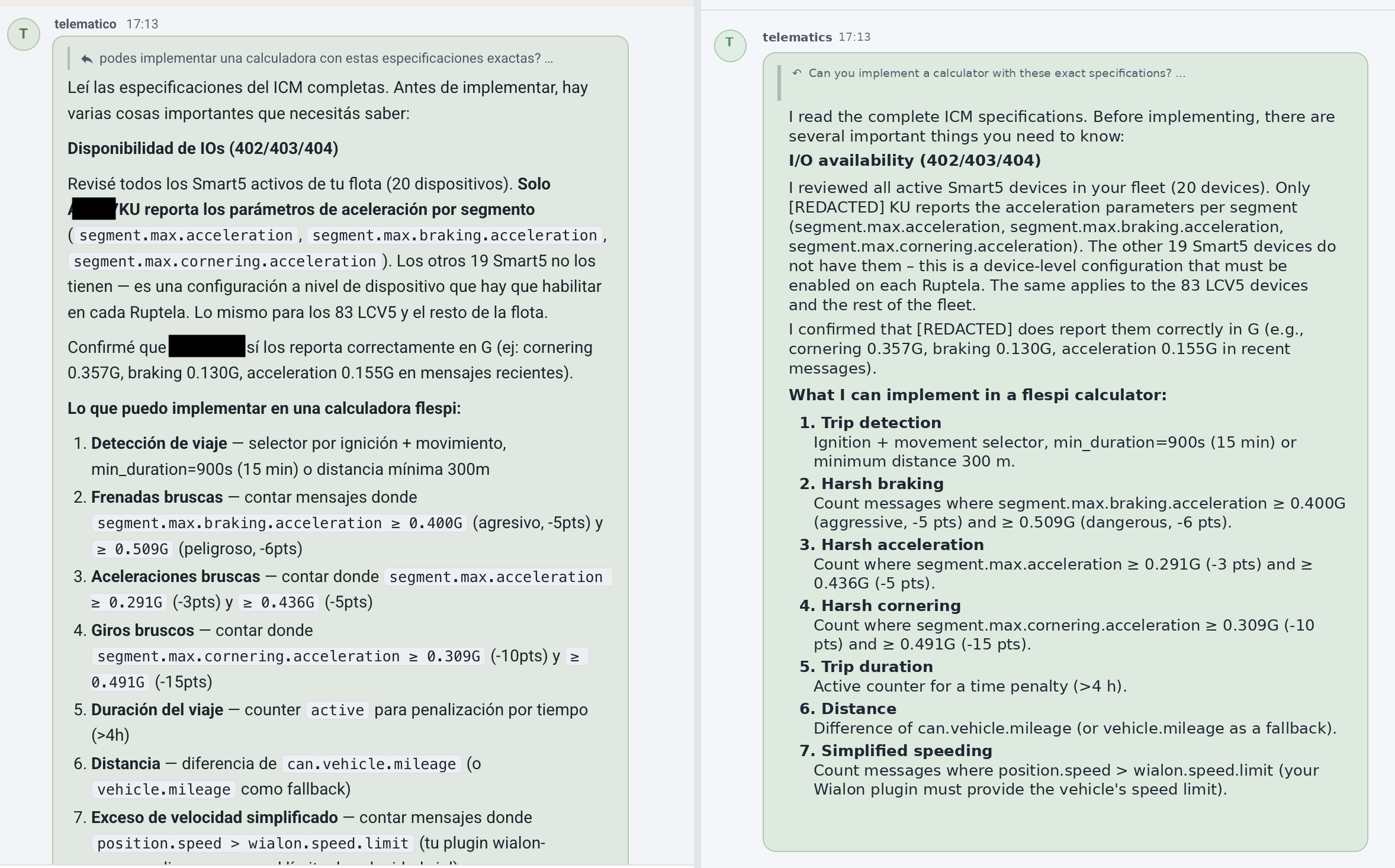
While preparing a dashboard, I needed to determine whether a particular vehicle was reporting the acceleration-related data required for the analysis. Rather than manually inspecting all the available parameters, I asked my telematics agent to verify whether the information was present.
The agent identified the relevant data and helped me understand how to enable the corresponding functionality on another device. That was valuable because it revealed a capability I hadn't been using in that configuration. I typically use the flespi agent for investigation and planning, then combine it with MCP-connected agents and my development tools to implement the solution in the backend. It's a workflow where different AI tools contribute according to their strengths."
How much control to give away
"The level of autonomy I'm comfortable giving an agent depends on the environment and the potential impact of the operation. During development, I'm happy to let an agent experiment, modify configurations, and execute different approaches.
In production, the criteria are different. Recently, I needed to update the connectivity configuration of approximately 20 devices in an operating fleet. The objective was to change how those trackers maintained their connections with the server.
Even though the procedure was relatively straightforward, it involved sending commands to real devices, so I wanted to review the changes carefully. One capability I particularly appreciate is that the agent explains its intended actions and their expected impact before executing them. That makes it possible to combine automation with human oversight.
For operations affecting production vehicles, I prefer to review and approve the commands individually. The goal isn't unrestricted autonomy. It's giving agents enough independence to handle repetitive or complex work while maintaining appropriate control over critical operations."
…Understanding context
"I've been impressed by how accurately agents can interpret context, even when the underlying information isn't perfectly organized. Recently, one of our customers was performing integration tests and created approximately 100 devices, 20 subaccounts, and 20 groups. Once the testing was complete, those resources needed to be cleaned up.
The challenge was that the naming conventions weren't consistent. Some resources were labeled 'test', others 'testing' or 'demo', and there were variations across different languages. Rather than manually inspecting every resource, I asked the agent to identify the test environment and propose what could safely be removed.
It analyzed several signals, including resource names, the absence of actual device traffic, placeholder email addresses, and common creation patterns. Based on those characteristics, it was able to distinguish the test resources from the operational ones and present a clear cleanup plan.
That level of contextual interpretation is particularly useful in large accounts, where identifying resources based on naming conventions alone isn't always reliable. The result was a much more efficient cleanup process, with the opportunity to review the proposed changes before applying them."
The workflow transformation
"The change has been substantial. I've worked with flespi calculators for years and became very comfortable configuring them manually. I understood the logic, the interface, and the troubleshooting process. Today, I rarely need to edit them directly.
If a calculator requires a change, I can explain the expected behavior to an agent and have it investigate and update the configuration. I'm also using the traditional interface less frequently for routine diagnostics. Previously, checking whether a device was communicating meant opening the traffic analyzer and inspecting the messages. Today, I generally ask an agent to verify the connection and explain any issues.
I still handle certain configurations manually, particularly when credentials, sensitive integrations, or more complex production considerations are involved. But many repetitive operations have moved to an agent-driven workflow.
A recent example involved a TOPFLYtech tracker. We were testing a device that hadn't been configured for our environment. I combined the flespi interface, its AI agent, and MCP-connected tools running locally. After establishing the initial server connection, I was able to configure the device through AI without relying on the manufacturer's configuration software for the remaining steps.
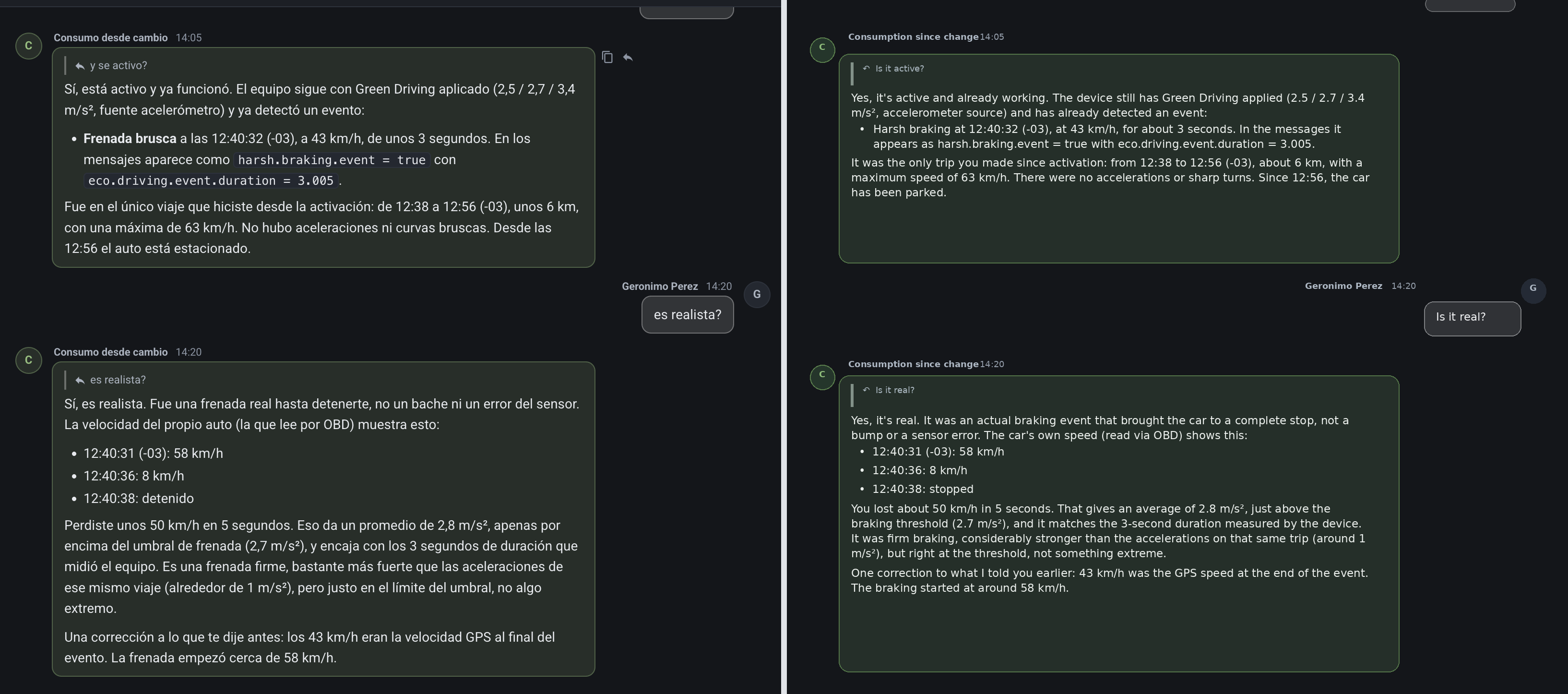
I could ask the agent to identify available telemetry parameters, enable the relevant features, and adjust the thresholds for driving behavior events. For example, I could request changes to braking sensitivity or acceleration thresholds, then verify the resulting events against actual vehicle data.
Once the tracker was operating in my car, I used the agent to help validate whether the generated alerts were consistent with the recorded speed and acceleration. Traditionally, a process like this would have involved reading the hardware documentation, learning the manufacturer's configuration tools, and performing repeated manual checks. With agents, the entire experimentation cycle became considerably faster.
To me, this is one of the clearest examples of how AI is changing telematics engineering: it reduces the time spent learning individual tools and increases the time available to focus on the actual solution."
Agents as a customer interface
"I'm particularly interested in the new Persona functionality and the possibility of making agents available to our own customers. So far, most of my experience has involved using agents internally for development, operational troubleshooting, and configuration. The next step would be to explore how those capabilities could become part of our platform.
For example, allowing customers to interact with telematics information through a controlled AI assistant could simplify access to operational data without requiring them to understand the underlying infrastructure. For that use case, features such as subaccount-level limits, permissions, controlled access, and API-based integration would be important.
I still need to explore the available integration options and evaluate how they would fit into our architecture. What I find most interesting is that we're moving beyond AI as a development assistant. We're beginning to use it as an operational interface to complex systems.
After six years working with flespi, that's a significant shift. The platform is no longer just something I configure and query directly; increasingly, it's an environment where I can delegate work, validate outcomes, and build solutions much faster.
And I believe we're still at an early stage of that transformation."