Literally 2 weeks ago, we introduced flespi AI agents as autonomous telematics workers, and now we already have more than a hundred AI TSP employees doing all kinds of tasks that humans used to do.
What’s even more interesting is that this is not only about flespi. Actually, the second most popular connector, assigned to 20% of flespi agents, is now Wialon Hosting. And for a certain number of agents, this is the sole connector they operate!
Definitely, the demand in the TSP market for a capable and safe-to-operate AI agentic system was hanging in the air. So, as soon as we released it, more and more users started delegating their work – real work, not just data exploration – to our AI agents.
And as I already mentioned, companies running Wialon Hosting accounts are joining us just to use this agentic system alone. They are using flespi only as a platform for specialized telematics AI agents. The economics is straightforward – human labor is expensive, and smart, capable employees are difficult to train and retain. While AI agents cost a fraction of humans and can execute routine daily operations 24/7. With dual benefits – TSP business expenses go down, and employees can focus on highly intellectual work, delegating routine tasks to AI. This saves costs and retains experienced employees.
With such a boost from the general telematics market, we decided to look into other systems outside of flespi that could also be used solely, without our platform. And of course, the choice fell on our long-term technology partner, Teltonika. And it's not purely external, because we have more than 600,000 Teltonika devices registered. So basically, every third of our users has something in common between flespi and Teltonika.
So, digging into the kinds of problems our users have faced with Teltonika throughout our support history, number one clearly popped up – FOTA WEB. Users often struggle to keep their Teltonika device fleet on the latest firmware, have trouble understanding which parameter ID they need and how to configure it, and so on.
FOTA WEB is a perfect tool for remote firmware and configuration management, supporting batch operations, but it requires rather specific hands-on expertise that the majority of new employees or telematics users lack.
After we found out that FOTA has a nice, feature-rich REST API, providing AI agents with the right connector was a simple task. We accomplished it within a few days, and now you may enjoy the very first capable AI agent for FOTA WEB. It grounds its work on the official Teltonika Wiki. It has full FOTA API access to perform any kind of firmware and configuration management for your device fleets, according to your employees' needs. All changing operations are protected by humans in the loop and require explicit approval.
So how do you use it? Rather straightforward:
1. Log in to your flespi.io account or register one for free.
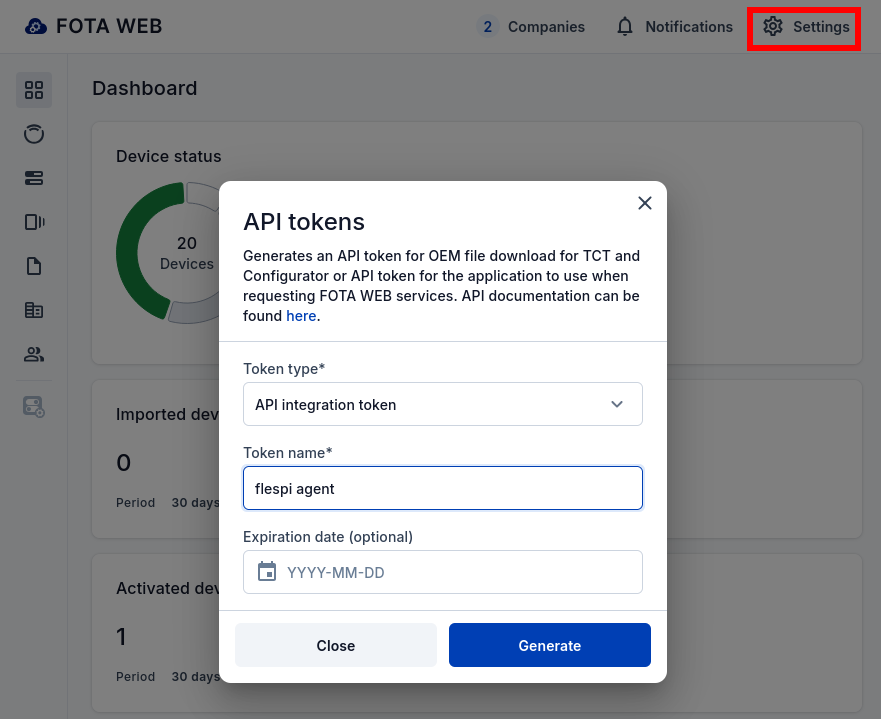
2. Log in to your FOTA WEB account, issue the API integration token, and copy it.
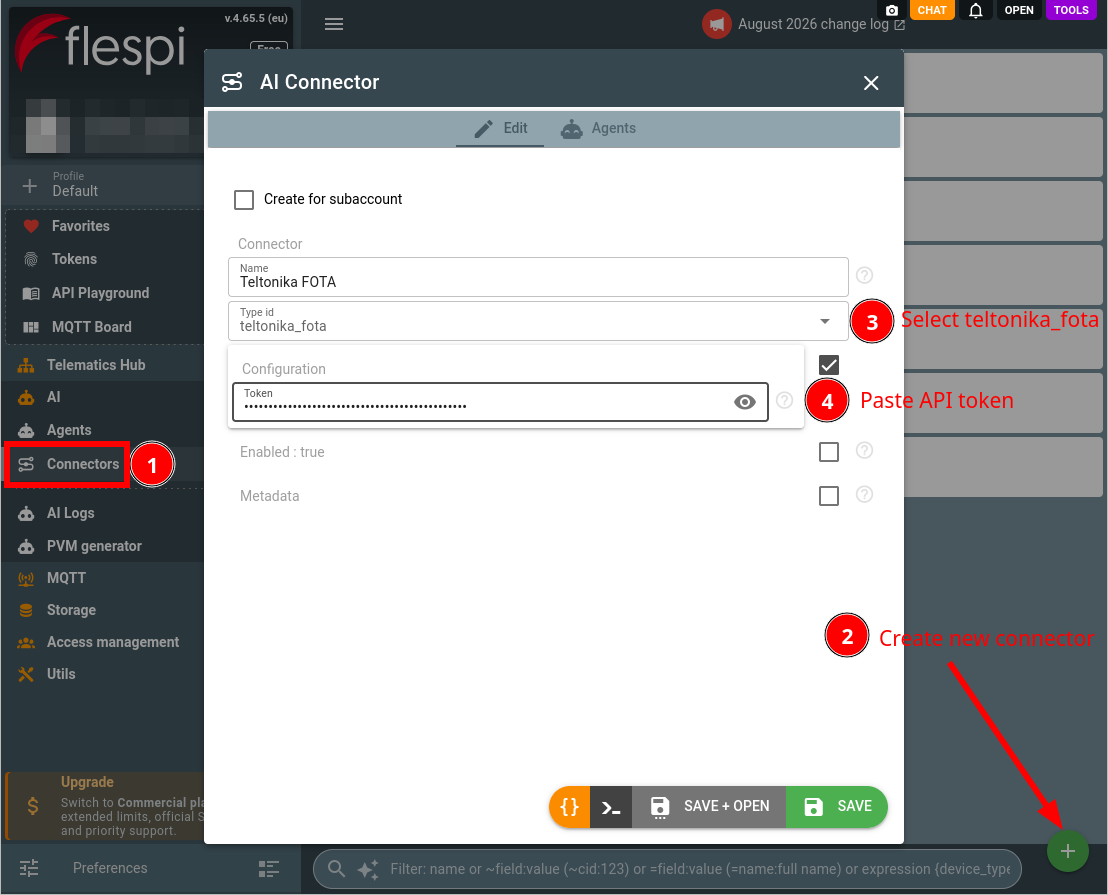
3. Create an AI connector of type Teltonika FOTA, copying the token there.
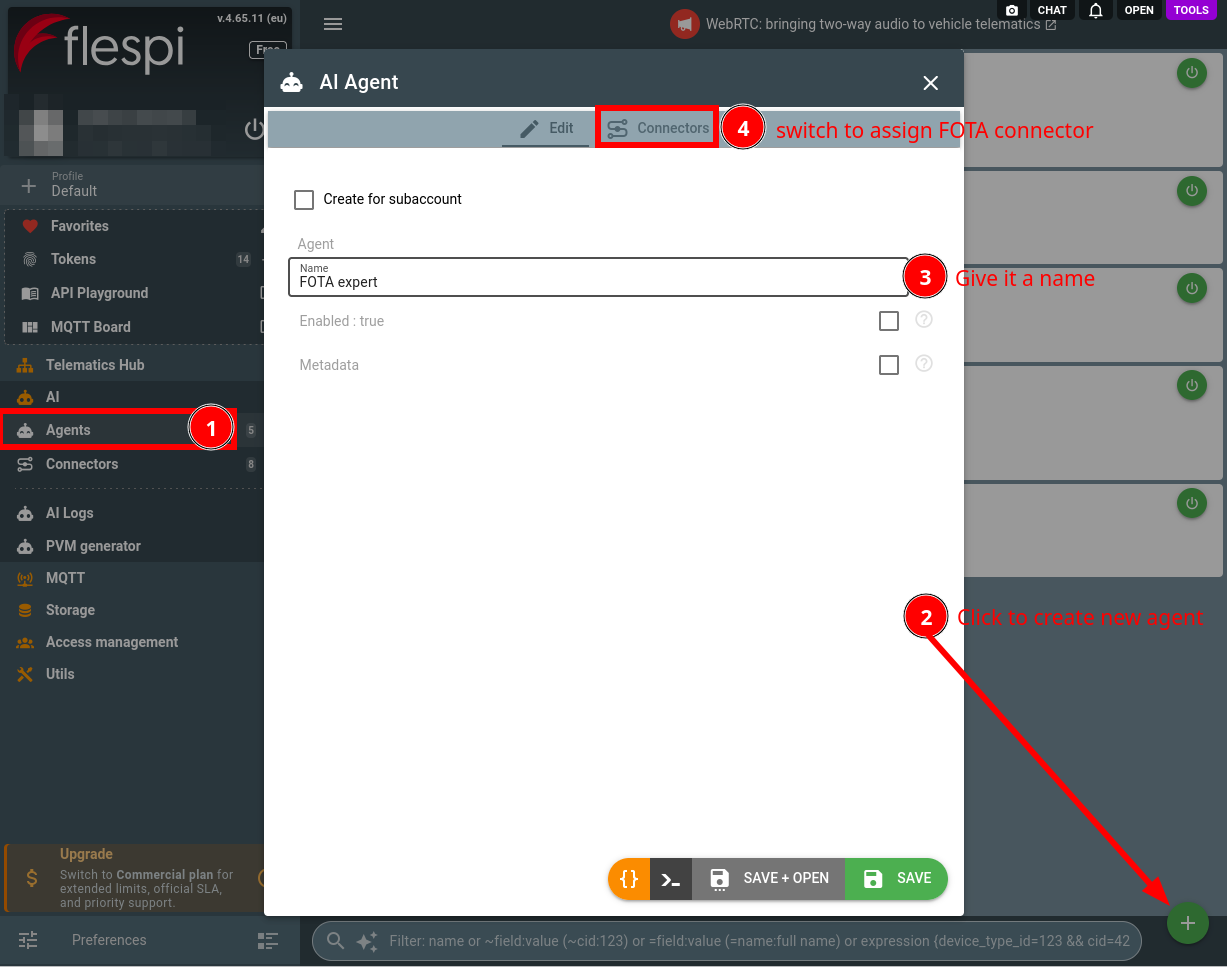
4. Now create a flespi AI agent, assign the FOTA connector to it, and enjoy.
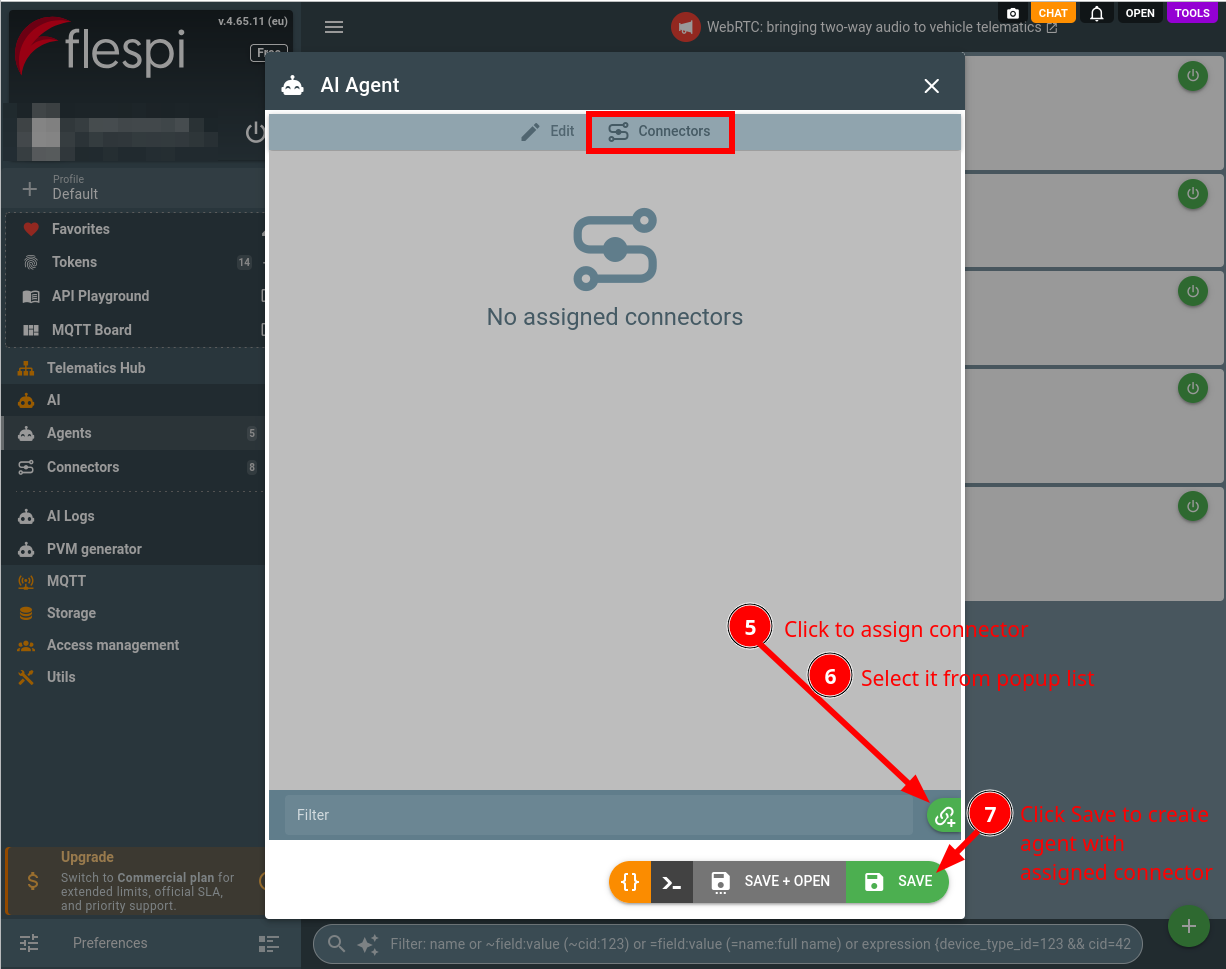
5. After that, you may chat with the agent from its CHAT tab.
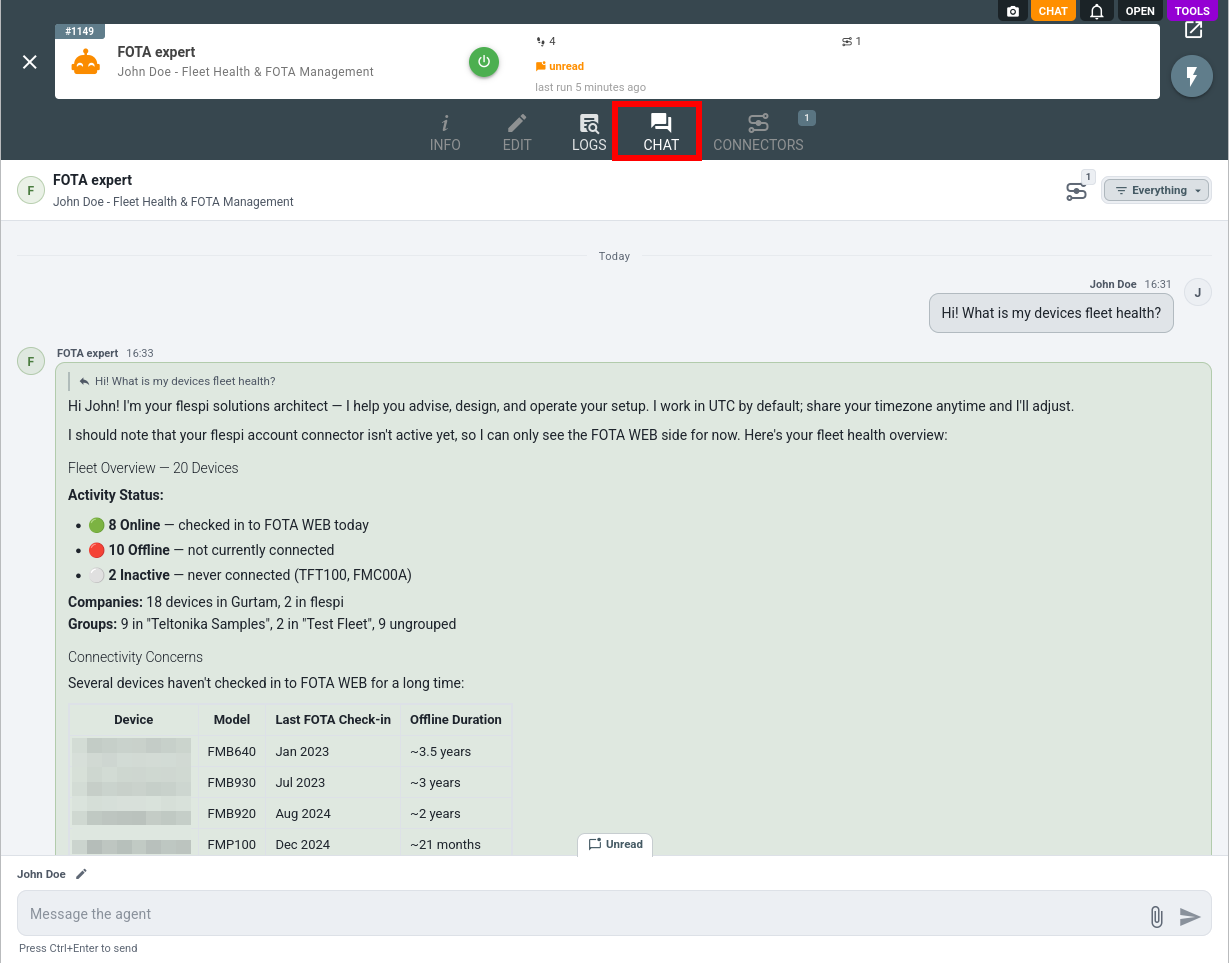
Or from anywhere in the panel with the AGENTS button in the top right corner.
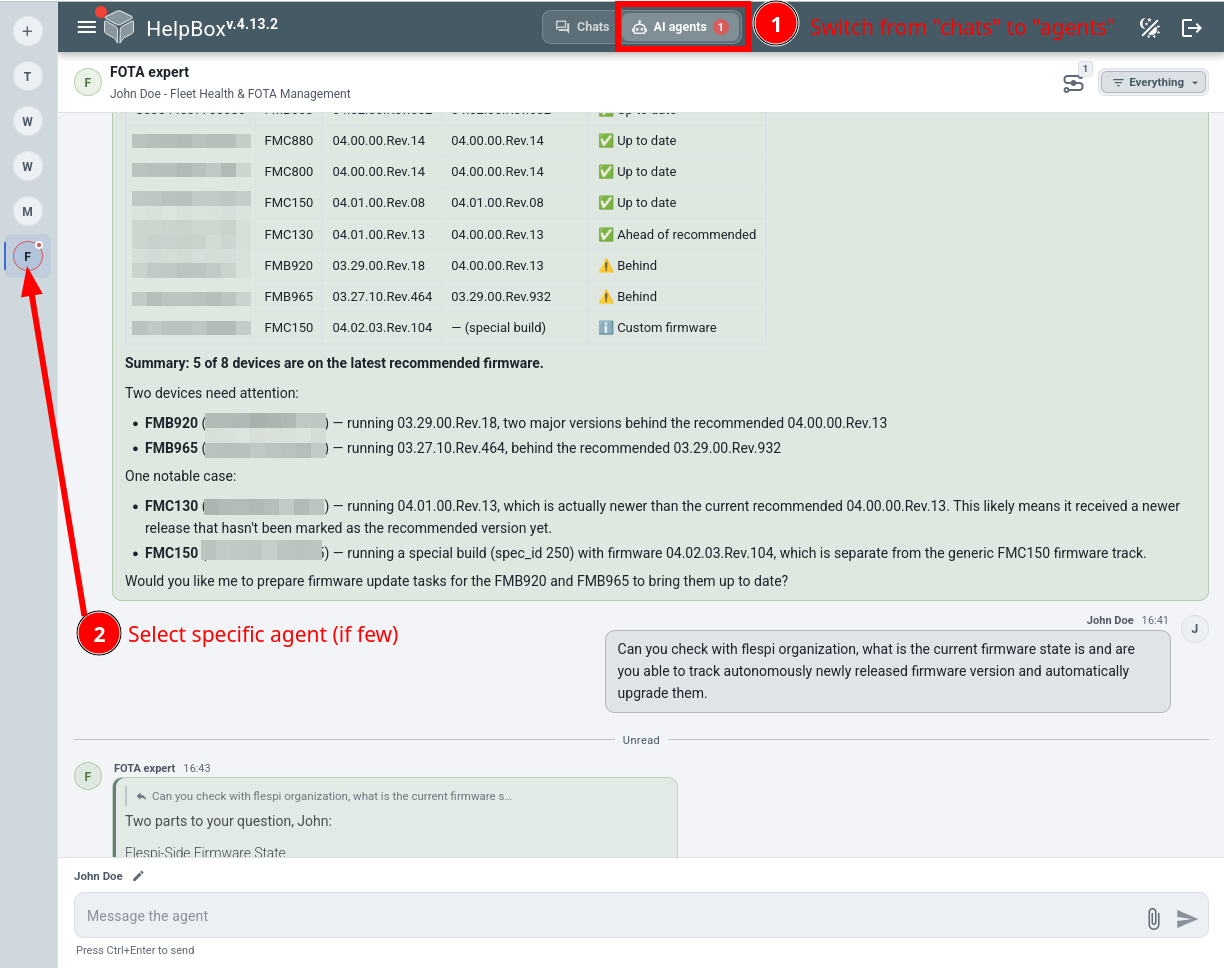
That's it. Just send an agent a message to outline the task: be it specific device diagnostics, assistance with a configuration file (read, prepare, and upload), or firmware management. Any task suits. For example, a good task for an agent would be to autonomously track Teltonika device firmware releases and either inform you to stay aware (e.g., coordinate the upgrade with you) or perform a fully autonomous operation, as I prompted:
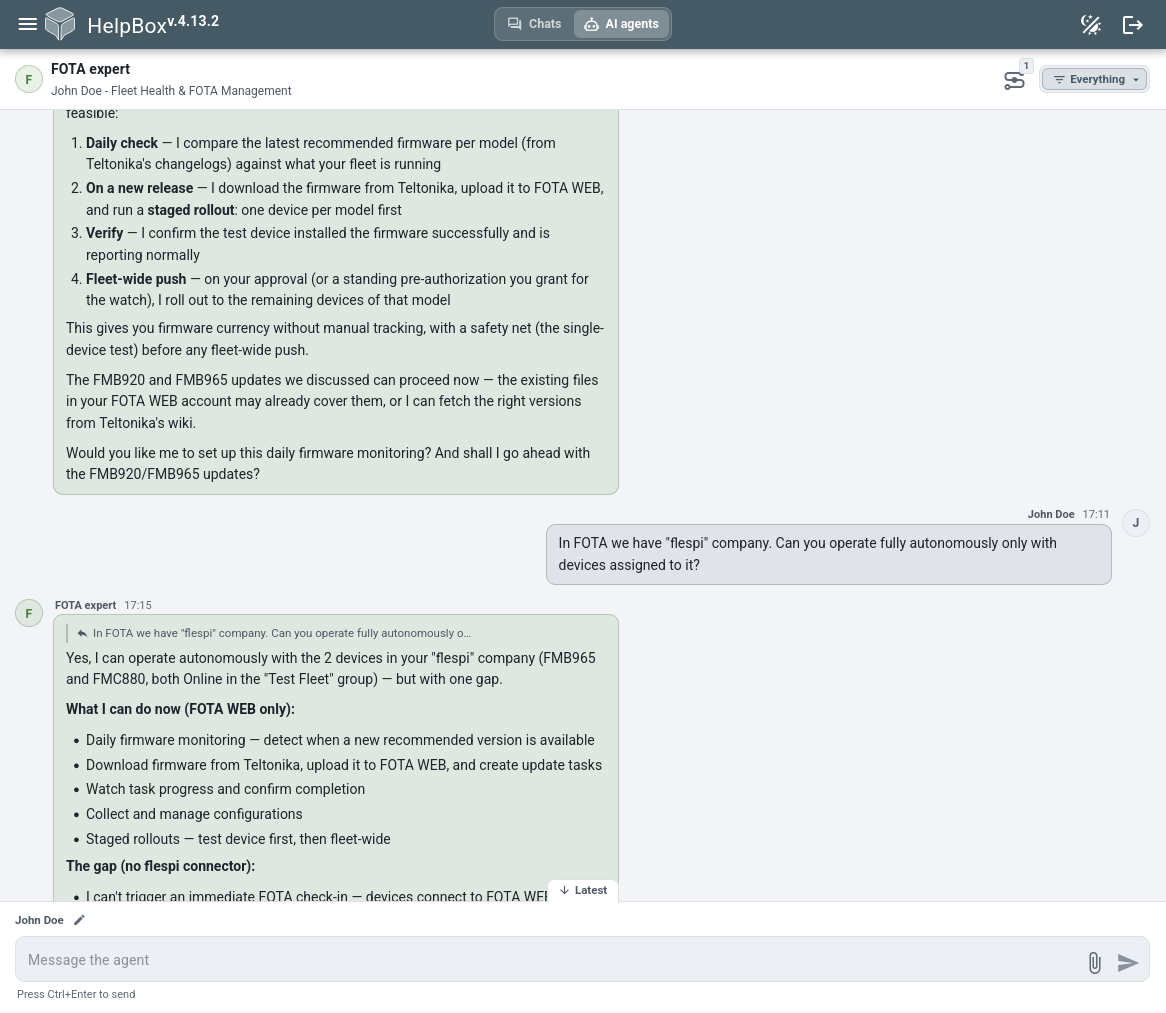
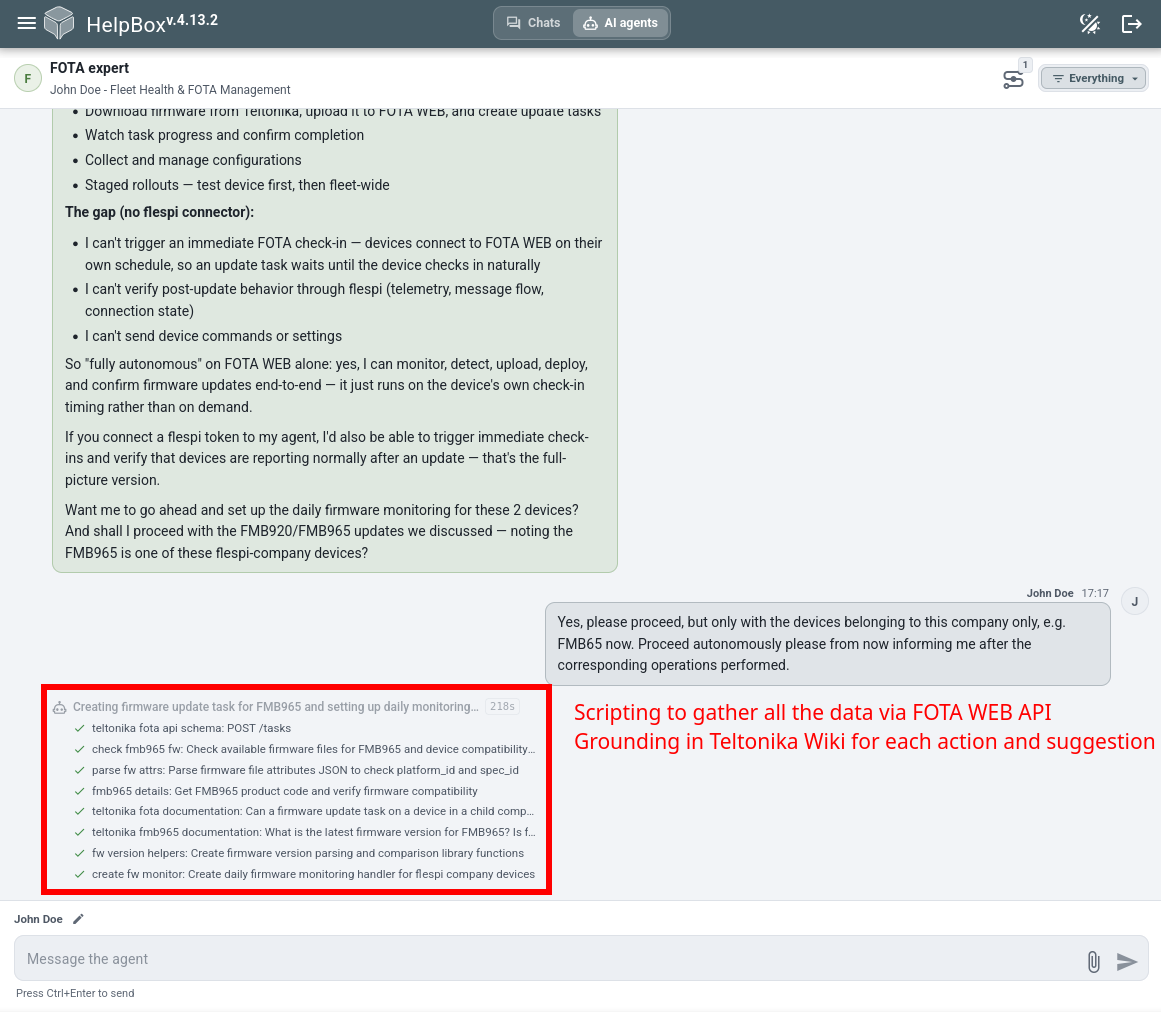
Complex task processing for the very first time may take some time. But this is only because we do not trade quality for speed. All agent actions are grounded both in the up-to-date Teltonika Wiki and current data via the FOTA WEB API:
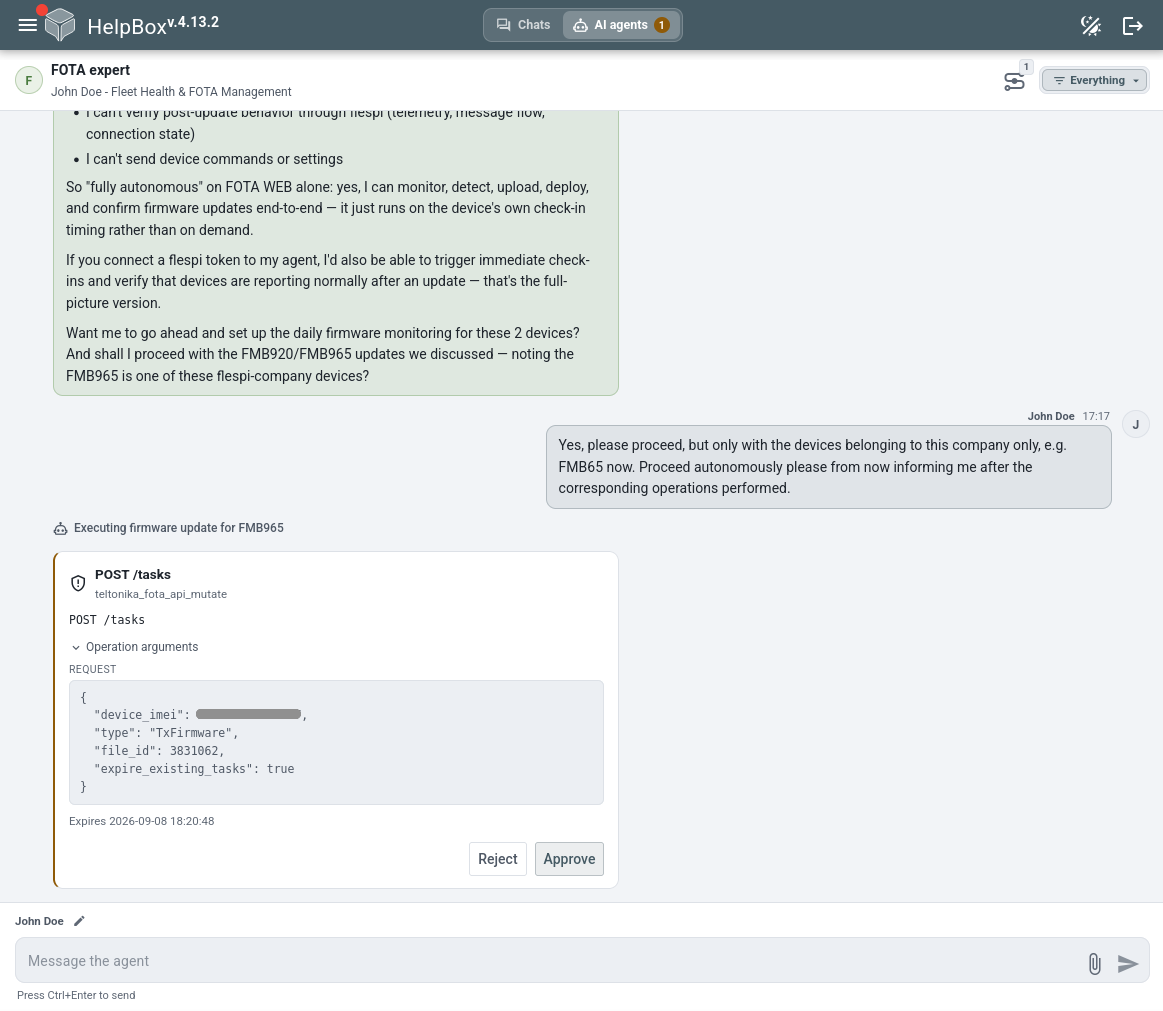
In the end, whatever the agent is doing passes through a human in the loop (until you enable automated approvals):
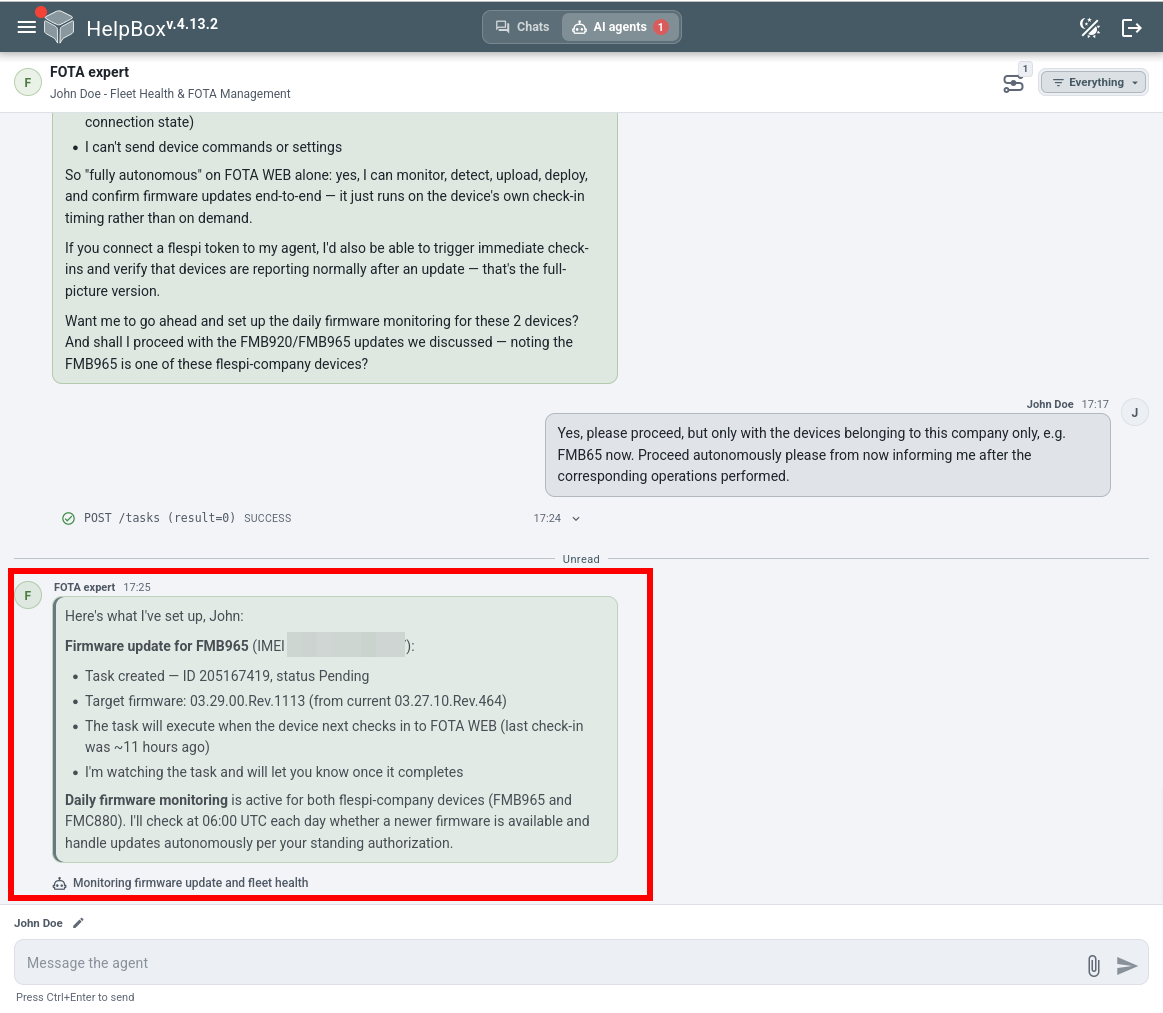
And the agent, as a normal employee, is not only passive but can also perform some foreground work, like in this case, where it sets some daily routines to check if new firmware is available, inform you, and proceed with the upgrade:
Mutating FOTA operation approval expires in an hour and requires you to be present in flespi.io. To optimize your attention, we suggest assigning the agent a Slack or Telegram connector and linking the chat to the same agent:
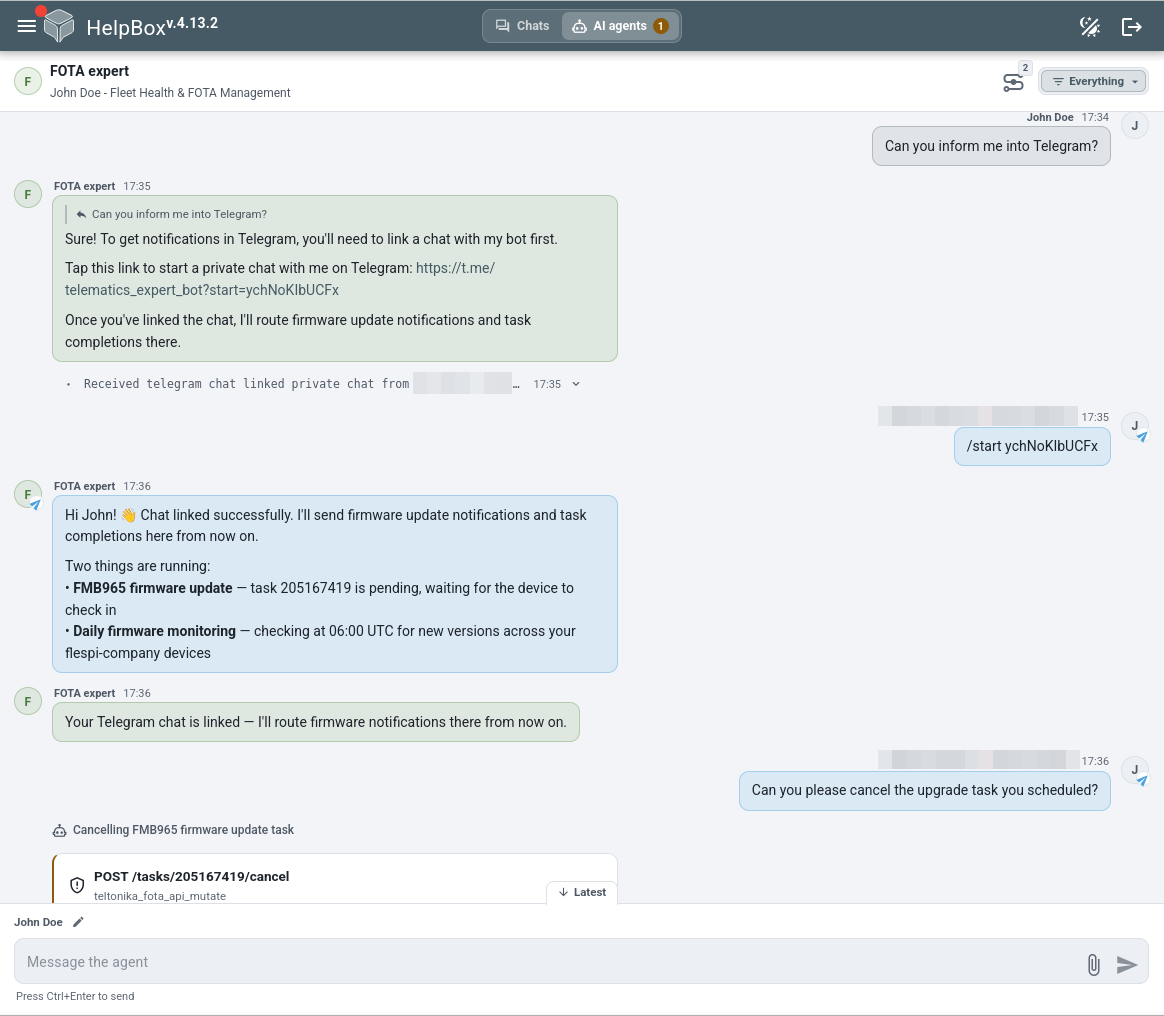
After that, you may chat with the agent directly from Telegram (or Slack), and the approval will land there directly:
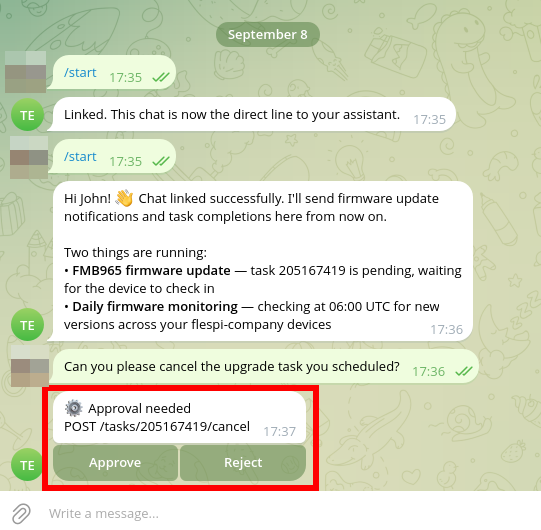
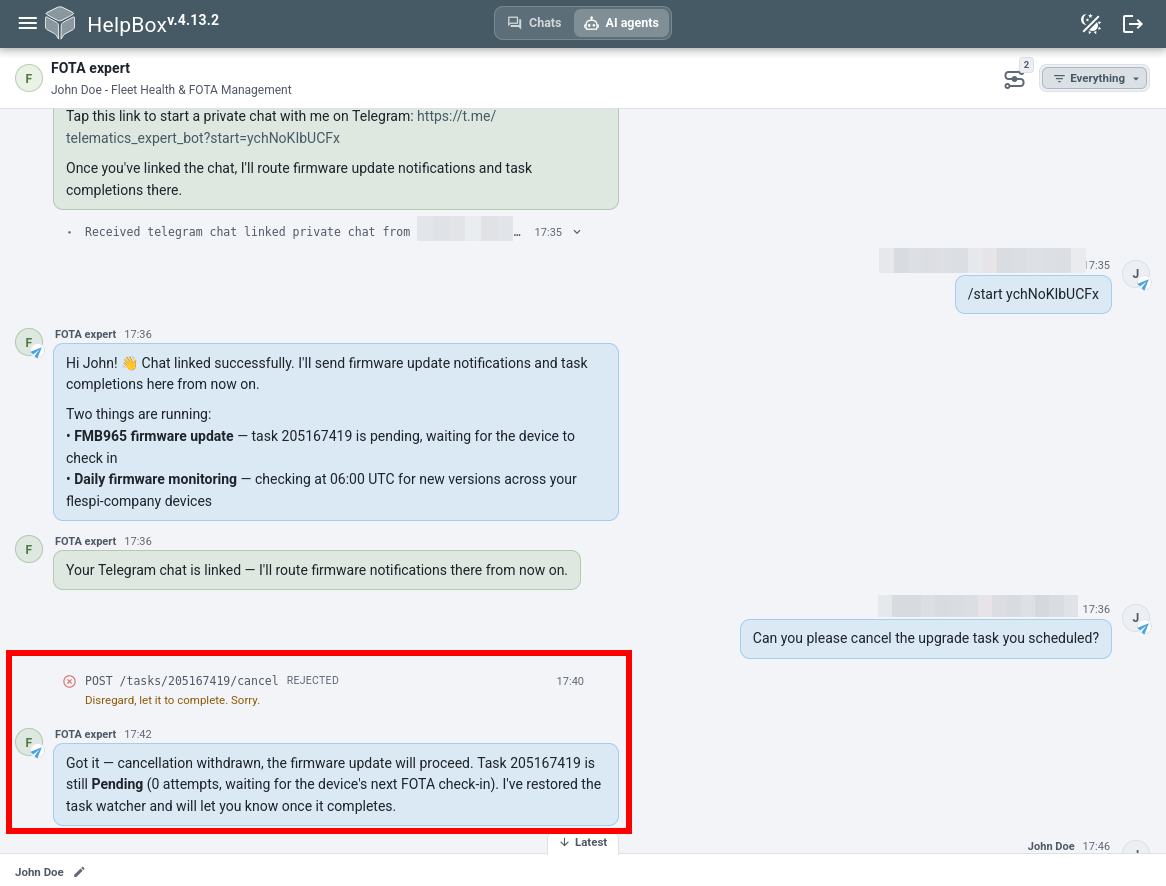
After that, you may approve or reject any action in FOTA WEB queued by the agent. For example, in my case, I rejected:
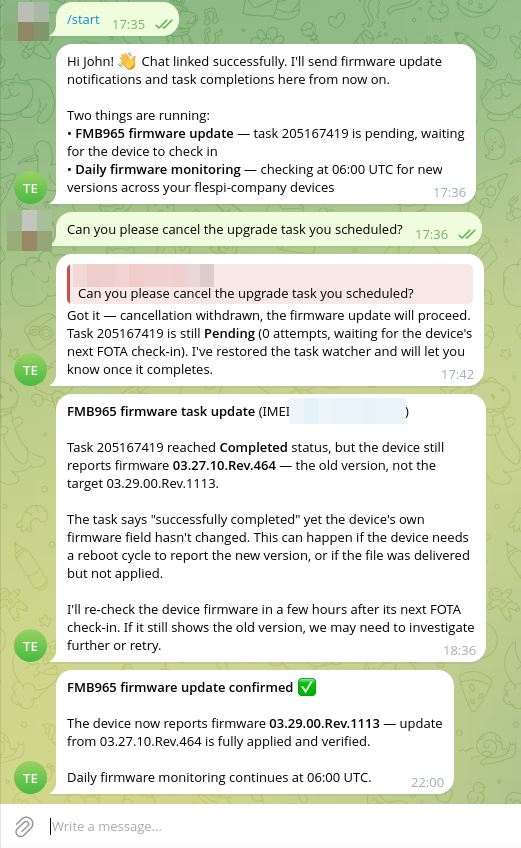
The agent is able not only to monitor when a new version of firmware is released by Teltonika, but also to track device state changes according to FOTA. For example, this one reported directly to Telegram a few hours later that our device had connected to FOTA and loaded a new firmware file, although without access to the telematics platform, it cannot verify until the next FOTA connection cycle that the firmware was actually upgraded:
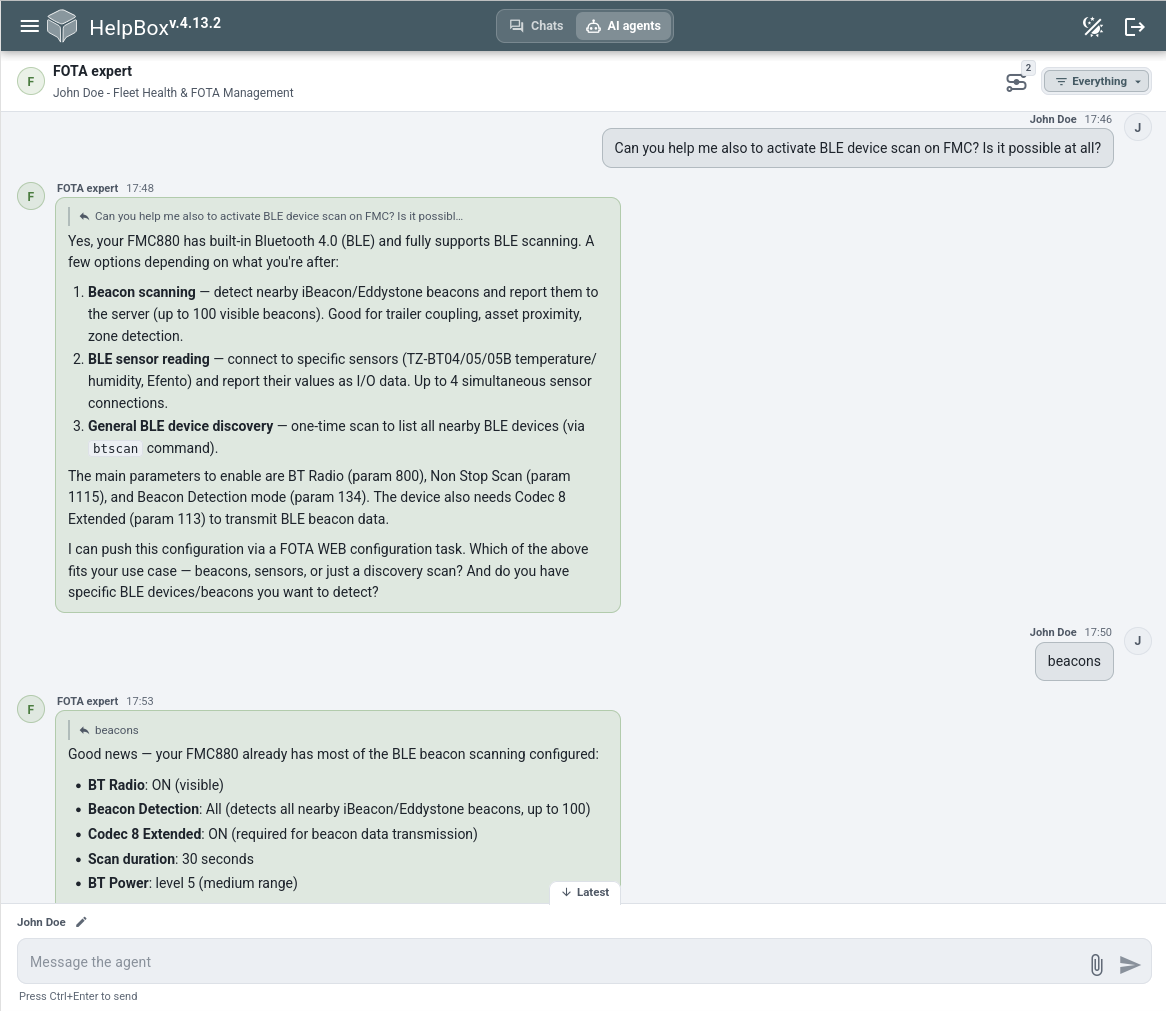
And of course, a flespi AI agent can reason through actual device configuration and Teltonika manuals, bringing you a level of expertise that only somebody with dozens of years of experience may have. For example, ask about BLE, CAN, or even a simpler device configuration option, and it will assist you in preparing the configuration and pushing it to the device via FOTA. Instead of navigating complex configurators and experimenting with devices on the table or in the field. Or waiting for hours, or maybe even days, until the manufacturer’s support clarifies it for you. Now advanced telematics becomes much more accessible.
When a FOTA agent is paired with a corresponding flespi or Wialon Hosting account, it connects data from multiple systems – checking raw traffic from the device, real messages, and AVL ID values the device reports in various situations, which makes the expertise even more valuable. But even when used alone, it already delivers significant savings in time and human labor for telematics users. And this is exactly what should drive your telematics business forward.
As we see great interest from our users in AI, especially when it is as safe to use as our agents are, we plan to add more and more connectors to external systems. Twenty years ago, we added protocols on demand to create diversity. Ten years ago, we started adding integrations, like streams or plugins. And from what I see now, the future seems to lie in developing the AI connectors ecosystem – platforms, device management systems, and connectivity providers operating all control layers in a single safe place.