In September 2026, flespi monthly uptime was 99.9965%, due to a flaky 26-second incident during an MQTT Broker upgrade, which was detected by our automatic downtime reporting system. Aside from this micro-incident, all other systems operated as expected and provided uninterrupted service.
By the way, during a month we usually provision around 100 upgrades to our services, and most of them are deployed invisibly, except for two connection-oriented systems – MQTT Broker and Telematics Gateway servicing channels. For these two systems, as their upgrades may cause some impact, such as device and MQTT client reconnections, we try to install accumulated updates in bulk up to a certain point. All other systems are continuously upgraded in the background. And if you want to check when a specific system was updated, you can find this information on the flespi status page.
Most of the updates in September went into the freshly released AI agents system. We released new connectors for Wialon Platform, Wialon Local, and Teltonika FOTA WEB.
All these connectors can be used by flespi agents independently, without any dependency on flespi itself. Essentially, flespi is used only as a convenient platform for hosting AI agents that work with various telematics platforms – kind of like Claude or ChatGPT, but focused purely on telematics.
Next in line are connectors to the most popular connectivity providers, allowing us to bring software, hardware, and connectivity systems together in a single reasoning layer.
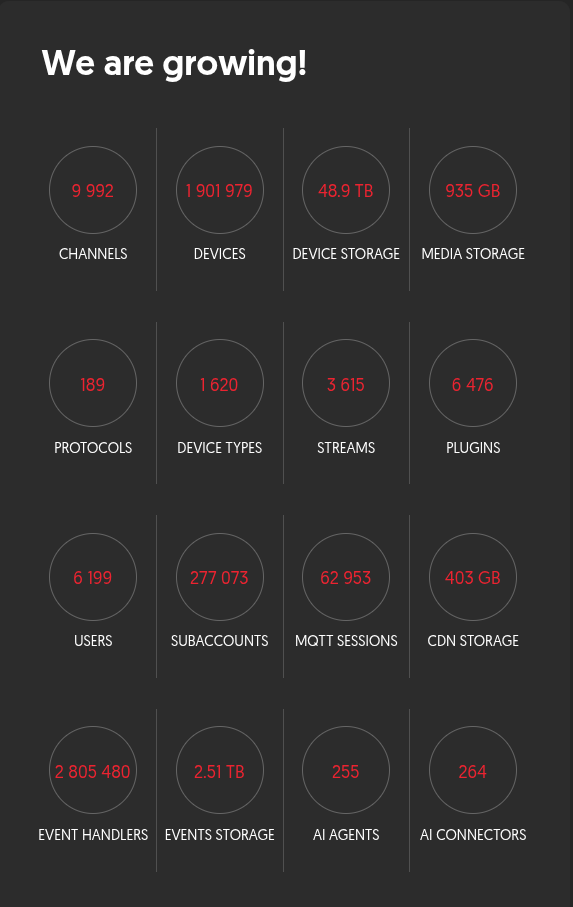
We receive a lot of feedback on how agents are positively changing the way our customers' businesses operate. Some of our users already have agents running with 200–300+ reasoning steps accumulated during their very first month. More than 250 AI agents are now working, and their number is constantly growing. Or, to put it another way – we have already supplied more than 250 autonomous digital workers for the telematics industry.
The most valuable returns, I think, come from non-recurring tasks such as diagnosing a problem with a device, tracking its state changes, performing complex multi-step provisioning of an entity, and so on.
Even a relatively straightforward job like creating geofences for US states, European countries, or districts in a city in Wialon or flespi may take a few hours of manual mouse-clicking – or at least dozens of minutes when using an external agent like ChatGPT or Claude. With a flespi AI agent, this takes less than a minute of your employee's time.
If you go further and continue with platform-specific usage of these geofences – for example, creating notifications or configuring reports in Wialon, or looking at the flespi side, where it may involve calculators or webhooks – our agent can save you at least another hour.
All in all, such a task, from the initial description to a final working configuration on the platform of your choice, will take 3–5 reasoning steps and cost you just EUR 1–5 once you go beyond the AI credits included in your plan. Compare EUR 1–5 with 1–2 hours of your employee's time, and you'll see the significant difference.
Similar calculations can be applied to almost any kind of task in telematics. Looking into flespi itself, a flespi agent can analyze the performance of a third-party integration (your platform) very precisely by checking REST API, webhooks, plugins, stream logs, and configuration, and reasoning over this data. It can reveal and report issues with your integration that you might not even be aware of.
Calculators, webhooks, realms, token ACLs, PVM plugins – they have never been simple to configure, but with an agent, it takes just a few minutes of your time to describe the problem and the task.
When there is a problem with device firmware, a flespi agent can compile a detailed HTML report for the manufacturer in just two reasoning steps, instead of your employee typing the same information into an email. And if equipped with an email connector, the agent can even send the email to the manufacturer and communicate with them autonomously.
The most difficult part of this, of course, is adoption and trust. Delegating some work to an AI is not easy for humans. I think later this year we will share more about this, revealing some of the architectural components of our agents to highlight their unprecedented safety framework compared to other AI agentic systems.
To make this voyage even easier to try, we significantly increased the amount of AI credits included in each plan. Starting with Enterprise and even Pro plans, I think the majority of tasks given to agents will be covered by this included layer, so basically, it will be free for our users.
We also introduced three levels of intelligence, configured per agent. My personal recommendation is to stick with the standard level and maybe try economy mode for relatively simple tasks where no proactivity is expected from the agent.
Personally, I don't see any specific areas where advanced intelligence is currently required, except perhaps if you simply want to burn all your AI credits and get the maximum possible quality of work. But from my perspective, an agent running on standard intelligence is the best choice.
Another new system that may consume AI credits is the AI driving events plugin, or the corresponding MCP/REST method. This is a kind of ADAS/DMS validation system in the cloud, originally designed to address cheap AI on the edge (in devices) that generates a lot of false-positive events.
Based on WebRTC technology, we also developed a two-way audio communication system for capable devices. This was the last promised feature from this year's roadmap, by the way.
In tachograph functionality, we improved the system operating in mass deployments. The main focus was support in TBA for a network of multiple connected Lisle Design modules, allowing hundreds of company cards to be serviced by a single TBA application. Another significant improvement was the resumption of interrupted DDD file uploads, mostly due to connectivity problems, which should significantly improve the durability of remote file retrieval operations.
Minor adjustments were made to CDN – it can now be disabled to stop publicly serving its files – and to the msg-param-calibrate plugin, which now supports multiple sensors and tables, for example, multiple fuel tanks.
We are also actively developing the communication gateway for asset tracking based on BLE and Wirepas technology. So if you ever come across this kind of requirement in your projects, you can also offload it to flespi. BLE tag reporting is supported natively by the majority of protocols, and Wirepas can be accessed directly or via the Teltonika Wirepas Wi-Fi Gateway. If you need a ready-to-use platform for indoor tracking based on flespi, or want to see how indoor tracking can be used to expand your telematics business, check out GPS-Trace Tags.
And besides, we have reached more than 1,900,000 registered devices in flespi. With the current monthly growth of 40–50K devices, it means that we will most probably reach the 2,000,000 registered devices milestone by the end of this year!